Damage Resources · Water
My hardwood floor got wet and it's changing shape, can it be saved?
Often yes, if drying starts fast and nobody sands it too early. The shape it is taking tells you what is happening underneath.
- IICRC Certified #70193059
- CSLB #1114551
- Hemet-based
- Serving all of Riverside County
Read The Floor
What the shape is telling you
- Board edges standing higher than the middle, giving the floor a washboard feel underfoot.
- Board centers standing higher than the edges.
- Boards lifting off the subfloor entirely, or a whole row tenting up.
- Gaps closing up so tightly the seams disappear.
- A cloudy or white haze in the finish.
- A musty smell near the floor even after the surface is dry.
What's Actually Happening
The cause
Wood absorbs moisture and swells across the grain. Water on a floor does not just wet the top. It runs into the seams and wets the underside of the boards and the subfloor or slab beneath, and that underside is where the real damage develops. It is also why a floor that looks dry on top keeps moving for weeks.
Cupping means the edges are higher than the center, and it means there is more moisture underneath the boards than on top. It is a live imbalance, not a permanent verdict, and mild to moderate cupping often flattens out substantially once the floor is brought back to equilibrium.
Crowning is the opposite, centers higher than edges. It comes either from prolonged moisture on the top surface or, far more often in our experience, from a cupped floor that got sanded flat too soon. Sanding takes wood off the raised edges; when the underside finally finishes drying and shrinks, those thinned edges drop below the middle. That damage is permanent and it is why nobody should sand a recently wet floor.
Buckling is boards coming off the subfloor completely. Buckled boards get replaced.
Do This Now
Do this in the next 30 minutes
A few careful moves protect your safety and limit the damage. If a step isn’t safe, skip it and call us.
- 1
Stop the source, then get the standing water off now
Speed matters more on wood than on any other floor. Squeegee or wet-vac every bit of standing water immediately rather than letting it sit in the seams.
- 2
Pull up rugs and get furniture off the floor
Rugs hold water against the wood and their dyes can transfer. Move furniture off, or put foil or blocks under the legs of anything that has to stay.
- 3
Run the air conditioning and move air across it
Air movement and dehumidification help. Do not crank the heat to bake it dry, because fast uneven surface drying makes the imbalance worse, not better.
- 4
Photograph the floor and the source before anything is moved
Get the standing water, the shape the boards are taking, and whatever failed. Note the date. This is the record that shows the loss was sudden.
Avoid These Mistakes
Don't do this
These are the moves that turn a manageable loss into a bigger, costlier one.
- Do not sand it, and do not let a flooring contractor sand it, until the moisture readings have stabilized. This is the single most expensive mistake on a wet wood floor.
- Do not nail buckled boards back down.
- Do not assume a dry-feeling surface means a dry floor. The meter decides, not your hand.
- Do not put fans on high heat against the boards to speed it up.
Don't let anyone sand it yet
A cupped floor that gets sanded early is ruined for good. Call and we'll dry it properly first, on the meter.
How We Handle It
What we do when we arrive
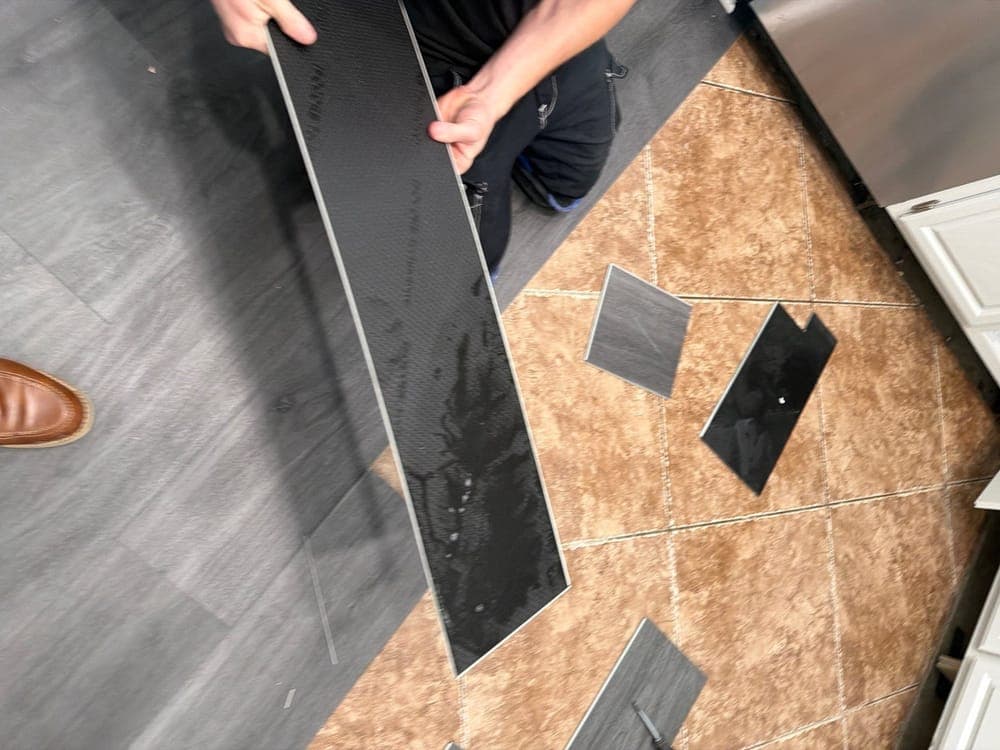
We extract fast, then get a drying system under the floor rather than just over it. Panel mat systems pull air through the flooring itself, under containment, with dehumidification running alongside, because water held in wood is the slowest kind to remove and blowing air across the top does very little.
Readings get logged daily against unaffected flooring in the same house, and drying runs until the two match rather than until the floor looks fine. That commonly takes considerably longer than drying drywall.
Then we tell you honestly what is salvageable. Solid hardwood caught early is a good candidate and has enough thickness to be sanded flat later, once it has stabilized. Engineered plank is a harder call: if the veneer has lifted or bubbled, the adhesive has failed and those planks get replaced, because delamination cannot be dried back out.
One local reality worth saying plainly: most homes around here are on slab, and wood floors on slab are usually glue-down engineered. When water gets between that plank and the concrete, mats cannot pull it out effectively and the adhesive bond goes. After a significant flood that is usually a removal and replace, and then the slab itself needs drying.
Your Claim
When insurance covers it
The usual rule applies. A burst supply line or a failed appliance that floods the floor is the sudden, accidental loss carriers commonly cover. A pinhole leak behind the refrigerator that cupped the floor over months is the one that gets argued as gradual.
Two things specific to floors. Carriers and homeowners often disagree about repairing a section versus replacing the whole floor, because a patch rarely matches; how that gets settled varies by policy. And the drying itself is usually treated as mitigation, which policies generally expect you to do promptly, even while the question of the floor is still open. We document; your carrier decides.
Questions
Hardwood Floors, frequently asked
Will my cupped floor flatten out on its own?
Often, at least partly. Cupping is a moisture imbalance between the top and bottom of the boards, and when the floor is dried back to equilibrium the boards frequently relax a long way toward flat. How much comes back depends on how wet it got, how long it stayed wet, and how fast drying started. What you should not do is decide it is permanent and sand it while it is still moving.
How long until it can be sanded and refinished?
Not until the moisture content has stabilized and matches unaffected flooring in the same house, which is usually well after the drying equipment comes out and is commonly measured in weeks rather than days. Sanding before that is what causes crowning, and crowning is permanent.
Can you dry it without tearing the floor up?
Frequently, yes. Panel mat systems draw air through the flooring assembly from above so the water underneath can leave without removing boards. It works best on nail-down solid wood over a wood subfloor and is much less effective on glue-down plank over a concrete slab, where the water sits in a place the system cannot reach.
Get Help Now
Request a free inspection
The Service That Handles This
Where We See It
Related Resources
24/7 Emergency Response
Damage won't wait. Neither do we.
Call now for a free inspection and 24/7 response across Hemet and Riverside County. We handle the cleanup and document it for your insurer.