
Damage Resources · Water
My roof is leaking into the house, what do I do?
Stop the water from getting in, then find out how far it ran. Roof water travels sideways through the attic, so the damage is wider than the drip.
- IICRC Certified #70193059
- CSLB #1114551
- Hemet-based
- Serving all of Riverside County
What You're Noticing
The signs
- A brown or yellow ring on the ceiling, often growing after each rain.
- A ceiling that sags or bulges in one spot, which is a bag of water sitting on the drywall.
- Damp or matted insulation visible from the attic hatch.
- A musty smell in a closet, hallway, or upstairs room that does not go away.
- Bubbling or peeling paint on a ceiling or the top of an interior wall.
What's Actually Happening
The cause
On the tile roofs that cover most inland Southern California tracts, the tile is not what keeps water out. The underlayment beneath it is. Tiles shed the bulk of the rain; the membrane underneath handles whatever gets past them. When that underlayment ages out, or flashing fails at a chimney, valley, or roof-to-wall joint, or wind lifts a tile, water gets into the attic.
From there it almost never falls straight down. It runs along rafters and truss chords and across the top of the ceiling drywall, so the stain you see can be several feet from where the water actually came in. On the way it soaks insulation, which holds the water and hides it, and can spill over wall top plates into the cavities below.
That matters for timing. Insulation saturates within hours. Mold can begin on the paper backing of drywall in 24 to 48 hours, on the side you cannot see. By the time a faint ring appears on the ceiling, the hidden side is usually further along than the visible one.
Do This Now
Do this in the next 30 minutes
A few careful moves protect your safety and limit the damage. If a step isn’t safe, skip it and call us.
- 1
Move what is under it and catch the drip
Get furniture, electronics, and anything with value out from under the area, then put a container down. Lay a towel in the container so it does not drum all night.
- 2
If the ceiling is bulging, drain it deliberately
A bulge is holding water and can let go all at once. With a bucket underneath, put a small hole at the lowest point of the bulge and let it drain in a controlled way. A small hole you made beats a ceiling that comes down on its own.
- 3
Kill power to lights and fans in that ceiling
Water tracking along a ceiling reaches fixture boxes. Switch off the affected circuits at the breaker rather than testing the switch.
- 4
Photograph it before anything is cleaned or patched
Get the stain, the bulge, the wet insulation from the attic hatch if you can reach it safely, and the roof from the ground if anything is visibly broken. Take it with a time stamp.
Avoid These Mistakes
Don't do this
These are the moves that turn a manageable loss into a bigger, costlier one.
- Do not climb onto a wet tile roof. Tile breaks underfoot and a wet one is a serious fall.
- Do not push on a sagging ceiling to see how soft it is.
- Do not paint over the stain and hope. The cavity above it is still wet, and the stain will come back through.
- Do not wait to see if it happens again next rain. That wait is exactly what turns a storm claim into a wear-and-tear denial.
The stain is the small part
What matters is how far the water ran above it. Call and we'll map it before it becomes a mold job.
How We Handle It
What we do when we arrive
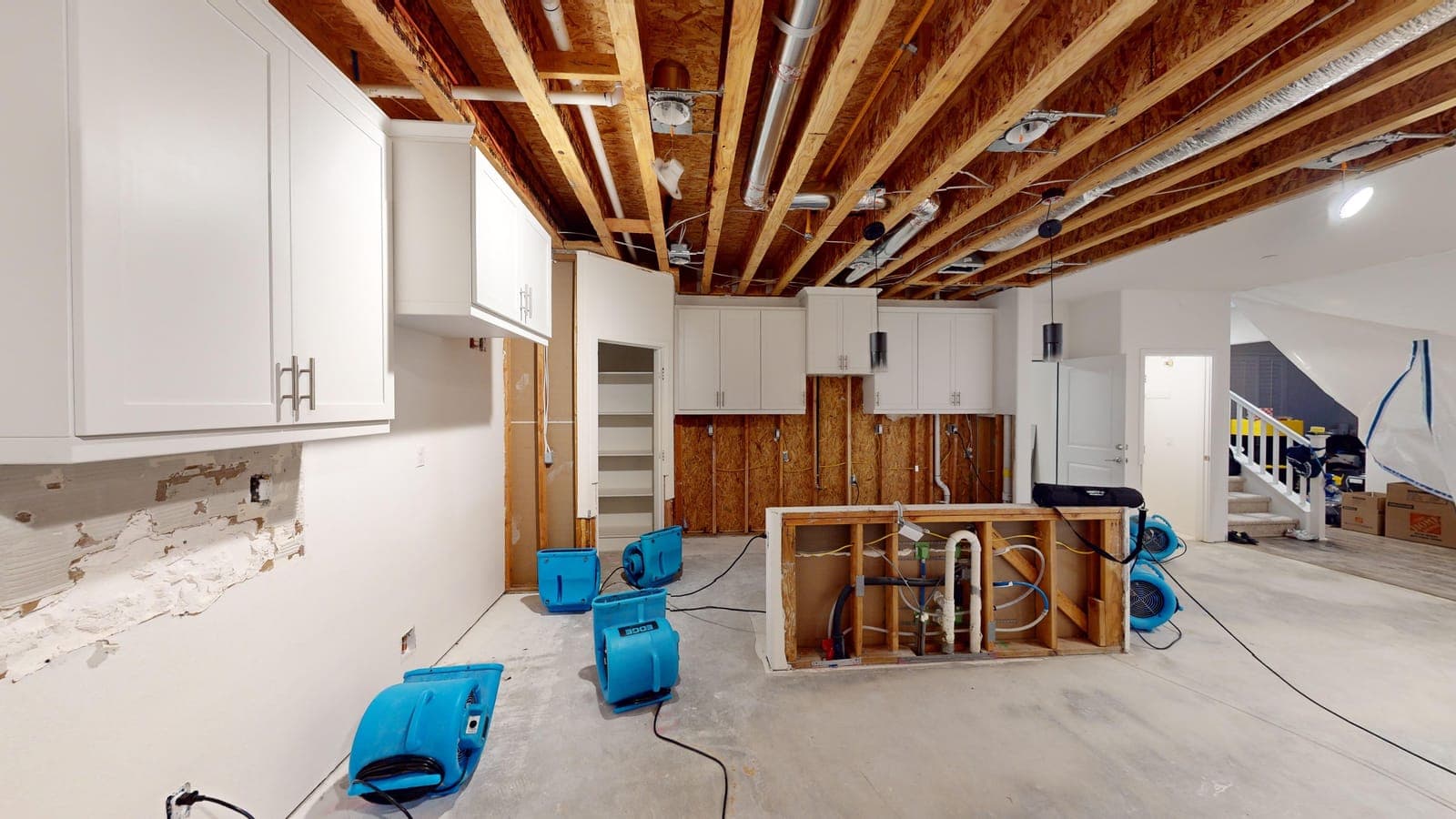
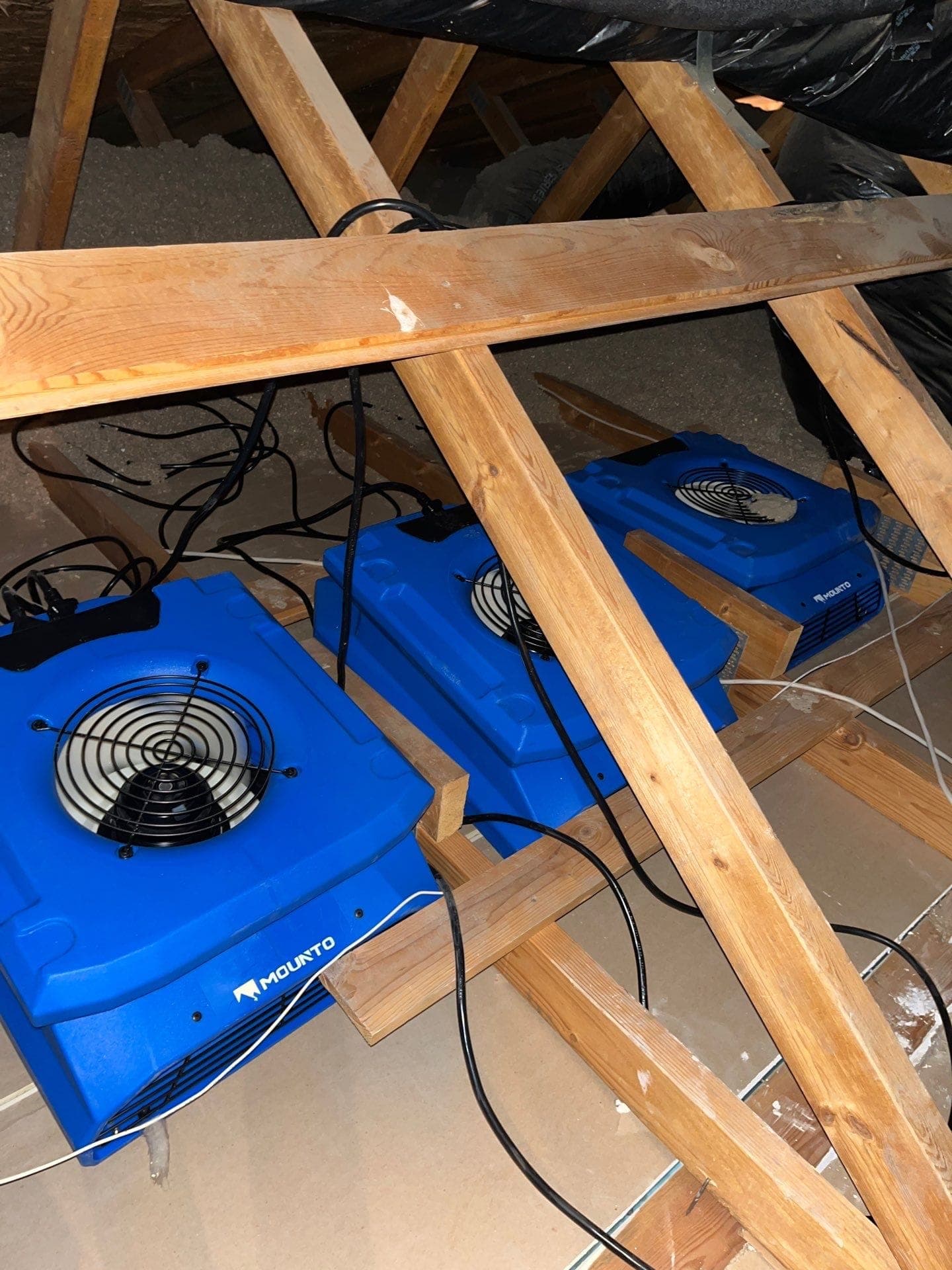
We tarp or otherwise stop the intrusion first, then map how far the water actually traveled with thermal imaging and moisture meters, in the attic, the ceiling, and the walls below. The wet area is almost always larger than the stain.
Saturated insulation comes out. It mats down, stops insulating, and holds water against framing. Drywall that has sagged, delaminated, or stayed wet past the mold window comes out too. What is sound and only damp gets dried in place with air movers and dehumidification, and we take daily readings against unaffected material in the same house until the numbers match.
Your Claim
When insurance covers it
The dividing line on roof leaks is sharper than on most losses. Carriers commonly cover interior water damage when a storm creates a sudden opening, a tile broken by wind, a flashing torn loose, wind-driven rain through storm damage. They commonly exclude damage traced to worn-out underlayment, deteriorated flashing, or a leak that has clearly been coming back for a while, because that reads as maintenance.
Some policies pay for the interior damage even when the roof repair itself is excluded, and some do not. That is policy specific and only your carrier can tell you. We can't decide any of it, but we photograph the intrusion point, the path the water took, and every drying reading, which is the part you can actually control.
Questions
Roof Leak, frequently asked
How long before a roof leak turns into mold?
Mold can begin within 24 to 48 hours on wet drywall paper and framing, and an inland attic in summer is a warm, favorable place for it. The growth usually starts on the back of the ceiling drywall, which is why a leak can look minor from below and be well advanced above.
Does the ceiling drywall have to come out, or can it be dried?
It depends on how wet it got and for how long. Drywall that is only damp and structurally sound can often be dried in place. Drywall that has sagged, gone soft, or lost its paper bond does not recover, and neither does saturated insulation. We meter it rather than guess.
Why is the stain nowhere near the broken tile?
Because water runs sideways. It follows rafters and the top of the ceiling drywall until it finds a low point or a seam, which can be several feet from where it entered. That is also why patching only what you can see tends to miss the wet area.
Get Help Now
Request a free inspection
The Service That Handles This
Where We See It
Related Resources
24/7 Emergency Response
Damage won't wait. Neither do we.
Call now for a free inspection and 24/7 response across Hemet and Riverside County. We handle the cleanup and document it for your insurer.