Damage Resources · Water
Sewage is backing up into my house, what do I do?
Stop using every water fixture, keep people away from it, and call. This is contaminated water and it is not a mop-and-bucket job.
- IICRC Certified #70193059
- CSLB #1114551
- Hemet-based
- Serving all of Riverside County
What You're Noticing
The signs
- Water rising out of a floor drain, shower, tub, or toilet, usually at the lowest point in the house.
- Several drains gurgling or running slow at the same time.
- A flush in one room causing water to come up somewhere else.
- A strong sewage odor that arrived suddenly.
- Backups that show up during or right after heavy rain.
What's Actually Happening
The cause
Something is blocking or has failed in the line that carries wastewater away from the house, either your lateral or the main it connects to. When the line cannot take the flow, it goes backwards and comes out at the lowest fixture it can find.
Under the IICRC standard this is Category 3 water, the most contaminated classification there is. It carries bacteria and other pathogens, and the important consequence is what that does to porous materials. Carpet, pad, drywall, insulation, and particleboard act like filters. They trap contamination deep inside where no disinfectant reliably reaches. That is why the standard response removes those materials rather than trying to clean and dry them.
Unlike a clean-water loss, this one does not need 48 hours to become serious. It is at its worst immediately, and heat makes it move faster.
Do This Now
Do this in the next 30 minutes
A few careful moves protect your safety and limit the damage. If a step isn’t safe, skip it and call us.
- 1
Stop using water anywhere in the house
Every flush, shower, and load of laundry upstream of the blockage comes back out at the backup point. Tell everyone in the house, including anyone who does not know it is happening yet.
- 2
Get people and pets away from it
Close the door to the affected room. Keep children, pets, and anyone with a weakened immune system well clear.
- 3
Cut power to that area if water is near outlets
Switch the affected circuits off at the breaker rather than reaching for a switch in a wet room.
- 4
Photograph it from a distance, then call both trades
You need a plumber to find and clear the line and a restoration crew to handle the contamination. They are two different jobs. If you think the problem is in the public main rather than your lateral, call the sewer district as well.
Avoid These Mistakes
Don't do this
These are the moves that turn a manageable loss into a bigger, costlier one.
- Do not walk through it without protection. Pathogens get in through cuts and splashes, not just by swallowing.
- Do not run a household shop vac over sewage. It sprays contamination into the air and the machine is finished afterwards.
- Do not pour bleach on soaked carpet and consider it handled. The contamination is inside the pad and the material below it.
- Do not run the HVAC if any supply or return is near the affected area.
- Do not put contaminated items in with clean laundry or contents.
This one should not wait until morning
Contaminated water gets worse by the hour, and heat speeds it up. Call any time and we'll contain it properly.
How We Handle It
What we do when we arrive
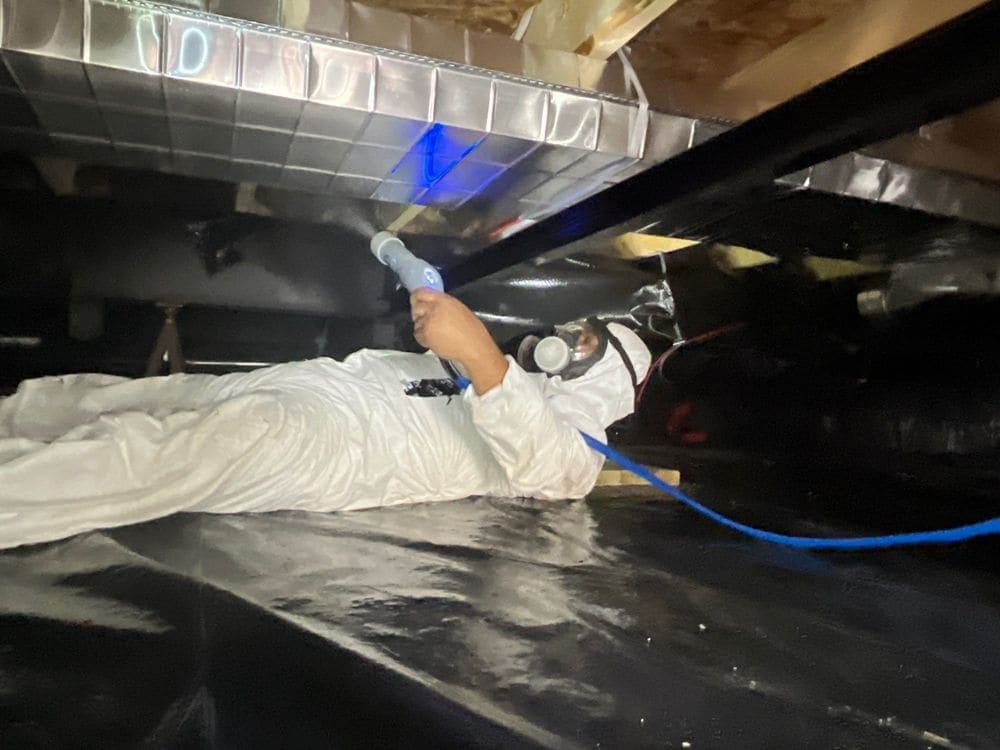
We set containment and HEPA-filtered negative air before anything else, so the work does not push contamination into the rest of the house, and the crew works in full protective equipment.
Porous materials that took the water come out and get bagged: carpet and pad, wet drywall, insulation, particleboard cabinet bases. The removal line is set by inspection and moisture readings rather than a fixed height, because the point is to get past the contaminated and wet material, not to hit a number.
What stays gets cleaned first and then treated with an EPA-registered disinfectant, in that order, because disinfectant does not work through soil. Then the structure is dried to standard with daily readings, and the whole sequence is documented.
Your Claim
When insurance covers it
This is the one loss type where the endorsement matters more than the peril. A standard homeowners policy generally excludes water that backs up through sewers and drains. Coverage comes from a separate water backup endorsement, which is usually inexpensive, often carries its own limit and deductible, and is the thing many homeowners find out they never added.
Two other things worth knowing. In most places the homeowner owns and maintains the lateral all the way to the main, sometimes including the section under the street. And if the backup started in the public main rather than your line, a claim against the district may be possible but is not automatic and has its own deadlines. Ask your district and your carrier directly. We document the loss and the scope; the coverage call is theirs.
Questions
Sewage Backup, frequently asked
Can I clean up a sewage backup myself?
A small amount on a hard, non-porous floor can sometimes be handled with proper gloves, boots, and eye protection and a disinfectant. Anything that has reached carpet, drywall, cabinets, or a large area needs containment, protective equipment, and controlled removal. The risk is not just what you can see; it is what soaks into materials and what gets aerosolized while you work.
What has to be thrown away?
Porous materials that absorbed the water. That typically means carpet and pad, wet drywall, insulation, particleboard, and paper goods. Hard, non-porous surfaces like tile, sealed concrete, and framing can usually be cleaned, disinfected, and dried. It is worth noting the distinction from less contaminated water, where carpet can often be cleaned and kept and only the pad is discarded.
Why does it back up when it rains?
Rain can get into the sewer system through cracked pipes, bad joints, and improperly connected drains. That extra volume can overwhelm a line that handles normal flow fine, which is why some homes only ever back up during a storm.
Get Help Now
Request a free inspection
The Service That Handles This
Where We See It
Related Resources
24/7 Emergency Response
Damage won't wait. Neither do we.
Call now for a free inspection and 24/7 response across Hemet and Riverside County. We handle the cleanup and document it for your insurer.