Damage Resources · Water
Water damage at my business, how fast can we reopen?
Often sooner than you think, because the work can be phased and contained. The clock that matters is lost business, not just the drying.
- IICRC Certified #70193059
- CSLB #1114551
- Hemet-based
- Serving all of Riverside County
What You're Noticing
The signs
- Ceiling tiles sagging, stained, or already on the floor.
- Water tracking along the underside of a drop ceiling and coming down in several places at once.
- A fire sprinkler head that has discharged.
- Carpet tile lifting, or dark seams spreading across a glued-down floor.
- Water showing up in the suite next door, or theirs showing up in yours.
What's Actually Happening
The cause
The physics are the same as a house. The building is not. Flat and low-slope roofs pond water and fail at seams, scuppers, and anywhere something penetrates the membrane. A single fire-sprinkler head puts out tens of gallons a minute. A supply failure above a drop ceiling soaks the tile, which disintegrates, and then the water rains down across a much wider footprint than the leak itself.
Commercial construction also moves water in ways a house does not. It tracks through demising walls into the neighboring tenant's space, which turns one loss into two insurance conversations. It gets into the HVAC plenum and the ductwork, which can then distribute humidity through the whole building. And glued-down carpet tile and vinyl over concrete hold water against the slab rather than letting it evaporate.
The time pressure is doubled. The same twenty-four to forty-eight hour window applies before microbial growth starts, and on top of that every hour closed is money.
Do This Now
Do this in the next 30 minutes
A few careful moves protect your safety and limit the damage. If a step isn’t safe, skip it and call us.
- 1
Shut the source, and know where the sprinkler valve is
For a sprinkler discharge, closing the control valve usually requires putting a fire watch in place and notifying your monitoring company. That's worth knowing before you need it, not during.
- 2
Kill power to the affected zones and clear people out
Standing water plus commercial electrical is not something to work around. Get staff and customers out of the wet area.
- 3
Start an incident log with times
When it was found, when the water was stopped, who was called and when. Commercial adjusters ask for this and it is much easier to write down as it happens.
- 4
Call your carrier, your restorer, and your landlord
All three. The landlord matters because the lease usually decides who is responsible for what, and the neighboring tenant needs to know if water is heading their way.
Avoid These Mistakes
Don't do this
These are the moves that turn a manageable loss into a bigger, costlier one.
- Do not run the HVAC through a soaked plenum to help it dry. You will move the moisture, and anything in it, through the whole building.
- Do not have staff shop-vac contaminated water without protective equipment.
- Do not throw out damaged stock before it has been inventoried and photographed.
- Do not sign an authorization from the first contractor who knocks without reading what you are assigning.
Every hour closed is the real cost
Contained, phased drying keeps part of the business open. Call and we'll scope it around your hours.
How We Handle It
What we do when we arrive
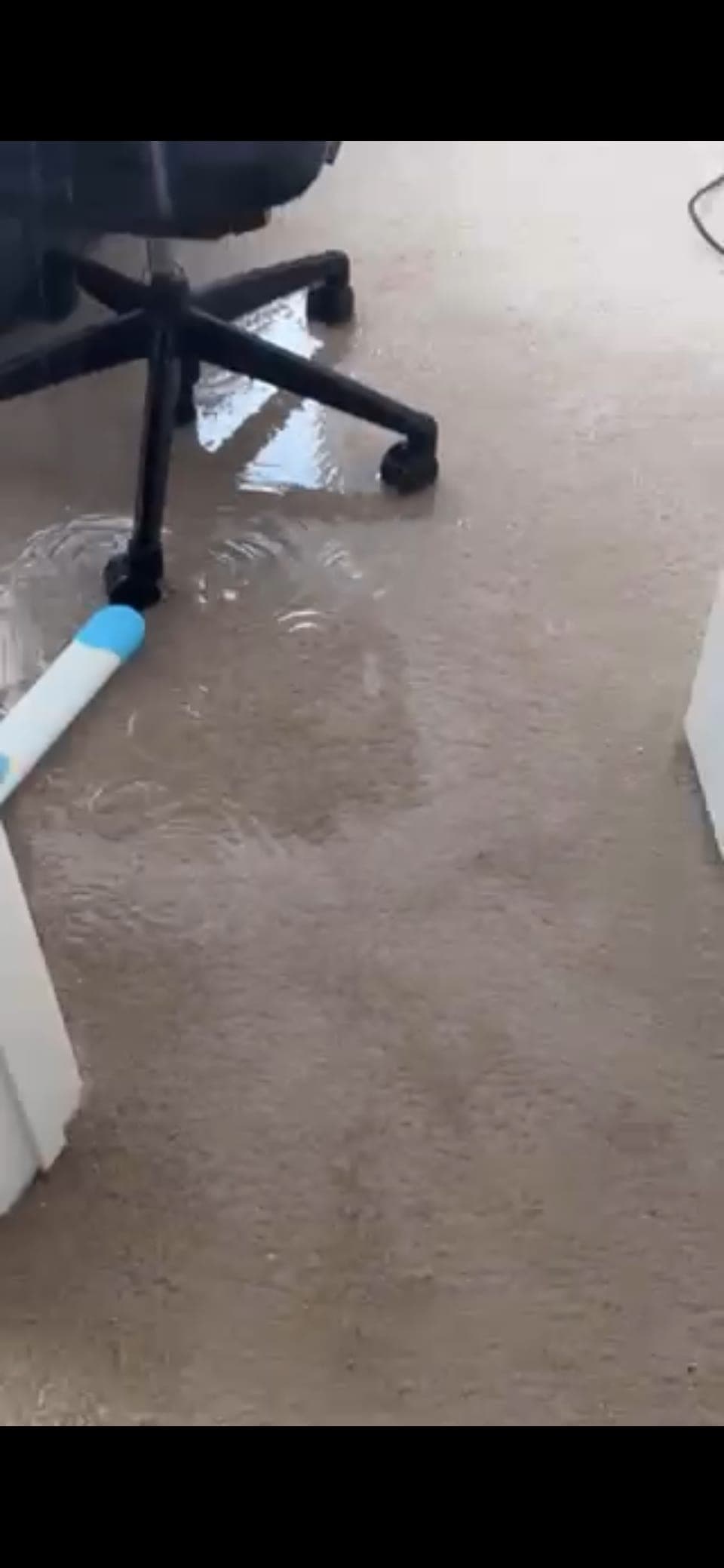
We scope for the building, not just the puddle: how far the water ran above the ceiling grid, whether it crossed into the next suite, and whether the plenum and ductwork took any of it.
Then we phase the work so you can keep operating where it is possible. Containment separates the wet area from the part of the business that is still open, and where the layout allows we work outside your hours rather than through them.
Documentation is heavier on a commercial loss because commercial adjusters expect it: daily readings, moisture maps, equipment counts, and a photo record clear enough to support a business interruption claim as well as the physical damage.
Contents get inventoried rather than swept up. Stock, records, and electronics are listed and photographed before anything moves.
Your Claim
When insurance covers it
Commercial property policies are built differently from a homeowners policy, and the difference that matters most is business income coverage, sometimes called business interruption. On a covered loss it can pay lost revenue and continuing costs while the space is being repaired, and on a closure of any length that is frequently worth more than the physical repairs.
The other commercial wrinkle is the lease. The building, the tenant improvements, and the contents are usually split between the landlord's policy and the tenant's, and the lease decides which is which. Read the repair and insurance clauses early rather than after the argument starts. Sudden versus gradual still applies as it does anywhere: a roof that has been leaking for months is a maintenance conversation. Limits, sublimits, and waiting periods vary widely, so confirm yours with your broker.
Questions
Commercial Water Damage, frequently asked
Can we stay open while you dry it?
Often partly, yes. If the wet area can be sealed off from the rest of the space, containment lets the unaffected part stay open while drying runs. Where the layout does not allow that, we look at working outside your hours instead. It depends on the building and how far the water traveled.
Who pays, us or the landlord?
Usually both, in different proportions, and the lease decides. As a general rule the building shell sits with the landlord's policy and your tenant improvements and contents sit with yours, but leases vary a lot. Check the repair and insurance clauses in yours early.
Can our stock, records, and electronics be saved?
Frequently, if they are dealt with quickly and handled correctly. The first step is a documented inventory, because that record matters for the claim whether the items are restored or replaced. Paper records and electronics need different handling from general stock and should not be left sitting wet while decisions are made.
Get Help Now
Request a free inspection
The Service That Handles This
Where We See It
Related Resources
24/7 Emergency Response
Damage won't wait. Neither do we.
Call now for a free inspection and 24/7 response across Hemet and Riverside County. We handle the cleanup and document it for your insurer.