
Damage Resources · Water
Water flooded my kitchen, what happens to the cabinets?
Most of the water is already under the cabinets. That hidden space is the job, not the floor you can see.
- IICRC Certified #70193059
- CSLB #1114551
- Hemet-based
- Serving all of Riverside County
What You're Noticing
The signs
- Water spreading across the floor from under the dishwasher, the sink, or behind the fridge.
- A dark line creeping up the cabinet toe kick, the recessed strip at the very bottom.
- Cabinet bases that feel soft, or a bottom shelf that has started to swell.
- Flooring lifting or cupping a room or two away from the kitchen.
- A musty smell in the sink cabinet that was not there before.
What's Actually Happening
The cause
Kitchens flood from three usual places: the quarter-inch line feeding the fridge icemaker, the dishwasher, or the supply connections under the sink. The icemaker line is the quiet one, because it runs behind an appliance nobody moves.
What makes a kitchen different from any other room is the toe kick. Your cabinets sit on a recessed base a few inches tall, and that leaves a dark, unventilated void running the length of every cabinet run. Water sheets across the floor, ducks under the toe kick, and sits in there. From that void it wicks upward into the cabinet bases and back into the drywall behind them.
Timing matters because of what those bases are made of. Particleboard and MDF swell within hours, and swollen particleboard does not come back. The glue bond that holds it together has already failed. Plywood and solid-wood boxes are far more forgiving. Past a day or two, the void behind the toe kick is a warm dark damp space, which is where the smell comes from later.
Do This Now
Do this in the next 30 minutes
A few careful moves protect your safety and limit the damage. If a step isn’t safe, skip it and call us.
- 1
Shut the water at the fixture, not the house
There is usually a small valve under the sink or behind the appliance. Close that one. If you cannot find it or it will not turn, shut the main.
- 2
Pull the appliance out and cut its power
Slide the dishwasher or fridge forward so you can see behind it, and switch off that circuit at the breaker before you put hands anywhere near standing water.
- 3
Get towels under the toe kicks
This is the part people skip. Push towels into the gap along the bottom of every cabinet run the water reached, not just the ones nearest the leak.
- 4
Empty the base cabinets and photograph everything
Take everything out of the lower cabinets so air can move and so you can see what got wet. Photograph behind the appliance too, and keep the failed hose or connector. That part is your evidence.
Avoid These Mistakes
Don't do this
These are the moves that turn a manageable loss into a bigger, costlier one.
- Do not run the dishwasher again to see whether it still leaks.
- Do not put wet contents back into the cabinets.
- Do not point one household fan at the floor and consider it handled. The floor is not where the water is.
- Do not tear cabinets out before they are documented, unless something is actually unsafe.
The floor is dry. Is the space under your cabinets?
That void holds water for weeks and nobody sees it until it smells. Call and we'll open it up and dry it properly.
How We Handle It
What we do when we arrive
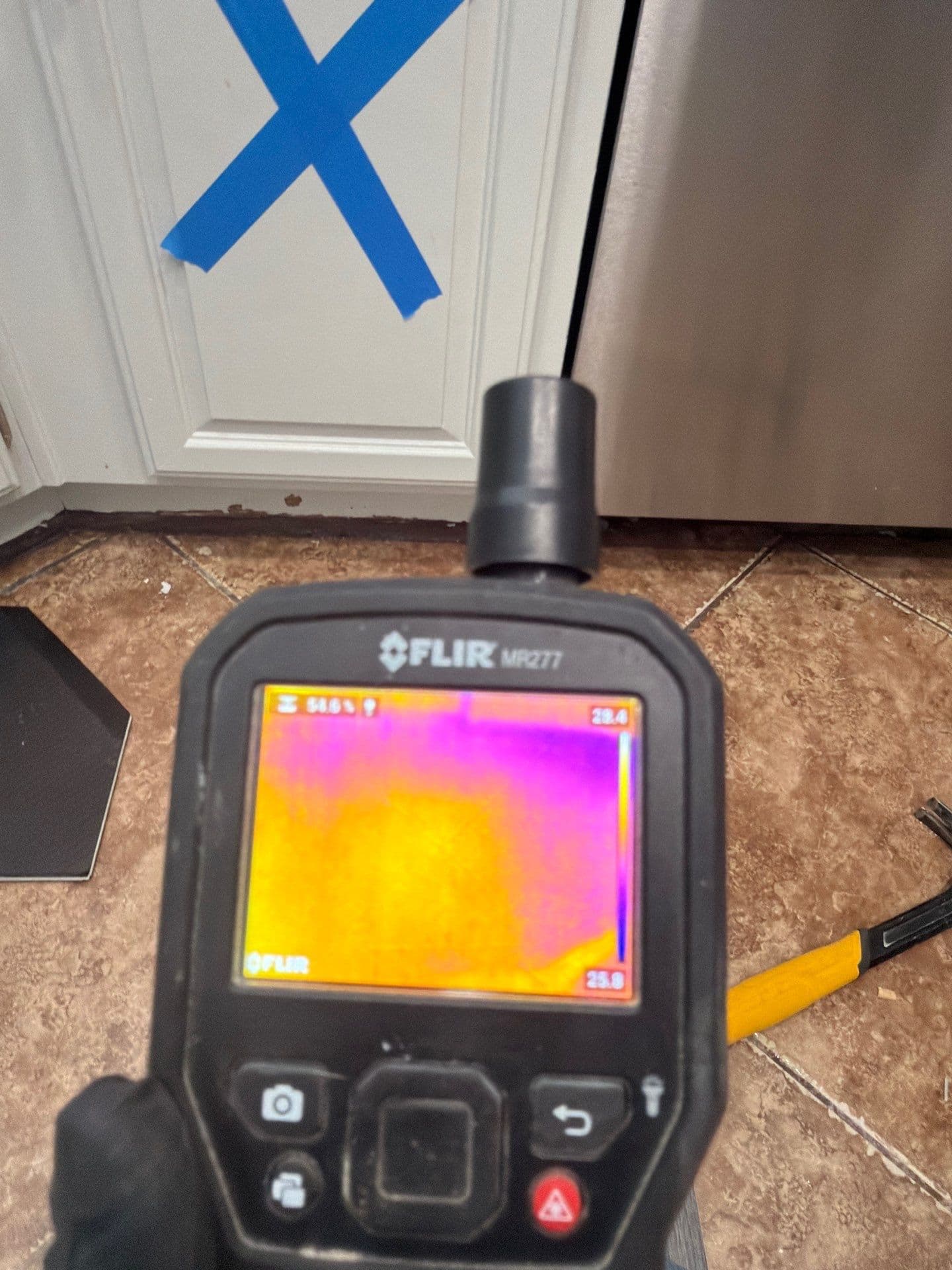
We map how far it went with thermal imaging and meters, behind the cabinets and into the rooms next door, because water under a floor does not stop at the kitchen doorway.
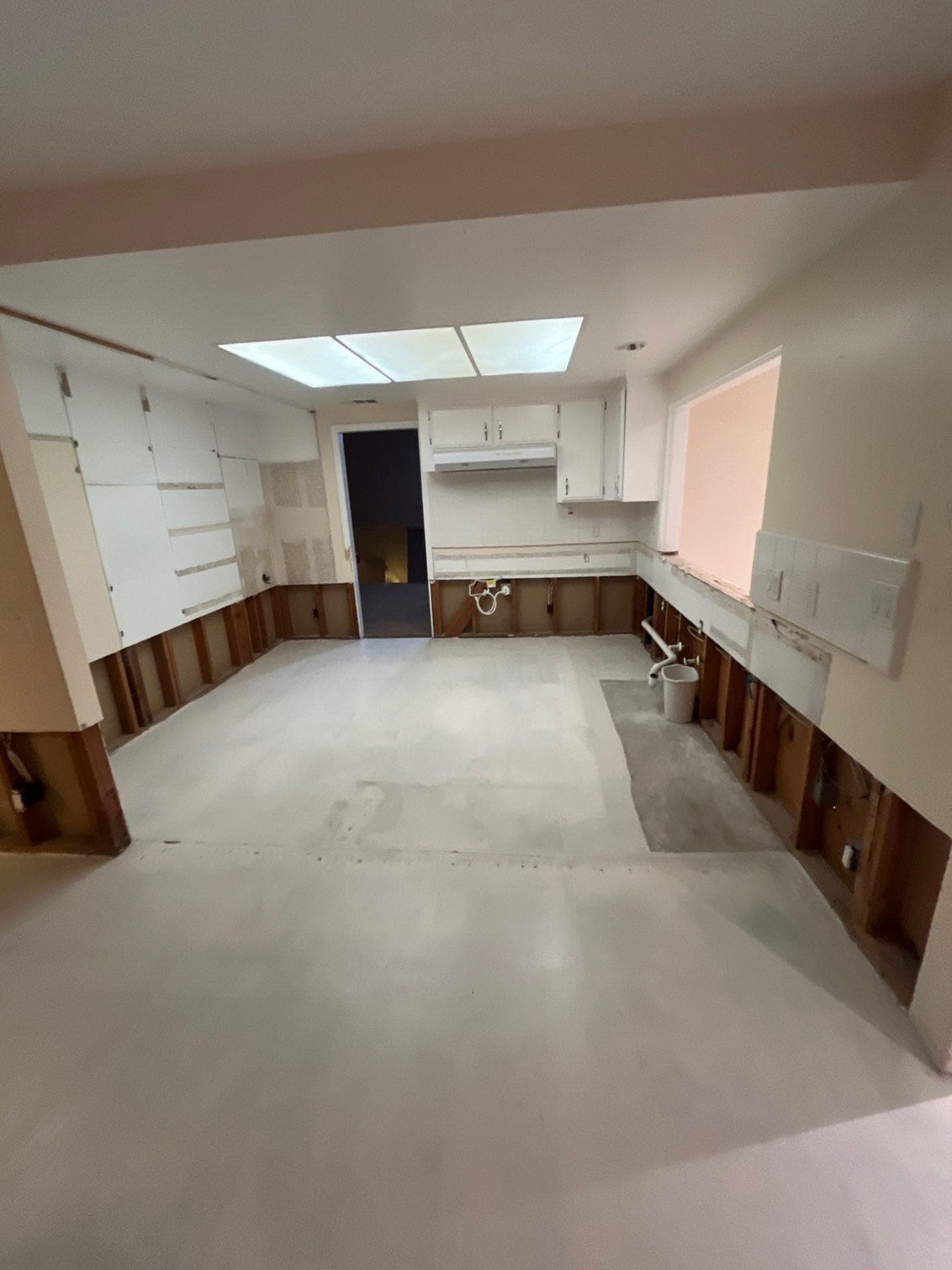
Then we open the toe kicks and dry the void directly. Toe-kick panels are cheap and replaceable, and taking them off lets us push warm dry air into the space under the cabinets rather than hoping it finds its way in. Where a cabinet back is trapping moisture we vent it. The wall cavity behind the run gets dried at the same time.
We keep the cabinets in place wherever the boxes are sound, and there is a practical reason beyond cost: pulling a cabinet run out from under a granite or quartz countertop is a good way to destroy the countertop. If drying starts quickly and the boxes are plywood or solid wood, three to five days is a normal run.
What we will tell you straight is when a base is finished. If a particleboard or MDF cabinet bottom has already swollen, no amount of drying restores it. That one gets replaced and we will say so rather than dry it and hand you a problem later.
Your Claim
When insurance covers it
An appliance or supply line that fails suddenly is the textbook covered loss. A burst dishwasher hose, a split icemaker line, a failed connector under the sink: commonly covered, though the appliance or the part itself usually is not.
The flip side is the most commonly denied kitchen claim there is: the slow leak. A fridge line weeping quietly behind the cabinet for months reads as gradual damage, and gradual damage is a standard exclusion. Some policies add hidden-water coverage for exactly this, and it is worth knowing whether yours does. We can't decide any of it. We document the failed part, the path the water took, and every reading.
Questions
Flooded Kitchen, frequently asked
Do my cabinets have to be replaced?
It depends what they are made of and how fast drying started. Plywood and solid-wood boxes can very often be dried in place. Particleboard and MDF bases that have already swollen cannot be, because the swelling means the glue has let go. We meter them and tell you which ones are which rather than guessing.
How do you dry under the cabinets without ripping them out?
By taking off the toe-kick panels along the bottom, which are designed to come off, and pushing dry air into the void through the openings. Where a cabinet back holds moisture we vent it as well. It avoids disturbing the countertops, which is usually the expensive part of removing a cabinet run.
Could there be mold behind the cabinets already?
If the water sat for more than a day or two, it is possible, because the space behind and under cabinets is dark, still, and slow to dry. That is exactly why we meter behind the run rather than judging by what the fronts look like.
Get Help Now
Request a free inspection
The Service That Handles This
Where We See It
Related Resources
24/7 Emergency Response
Damage won't wait. Neither do we.
Call now for a free inspection and 24/7 response across Hemet and Riverside County. We handle the cleanup and document it for your insurer.